
Literature
When an Italian journey returned to the Arab world
Carlo Guarmani’s El Kamsa and the thousand-year-old legacy of the Arabian horse, now brought back to its cultural homeland through Mohamed Eltedawy’s Arabic translation

Carlo Guarmani’s El Kamsa and the thousand-year-old legacy of the Arabian horse, now brought back to its cultural homeland through Mohamed Eltedawy’s Arabic translation
Before becoming a symbol, the Arabian horse was a voice of the desert. Imruʾ al-Qays, the great pre-Islamic poet, saw it charging forward and turning back within the same breath, like a boulder torn from a mountain and swept downhill by a flood. ʿAntara ibn Shaddād, poet and warrior, made the horse a witness to his own glory: when his courage was questioned, he would answer, “Ask the horses.”
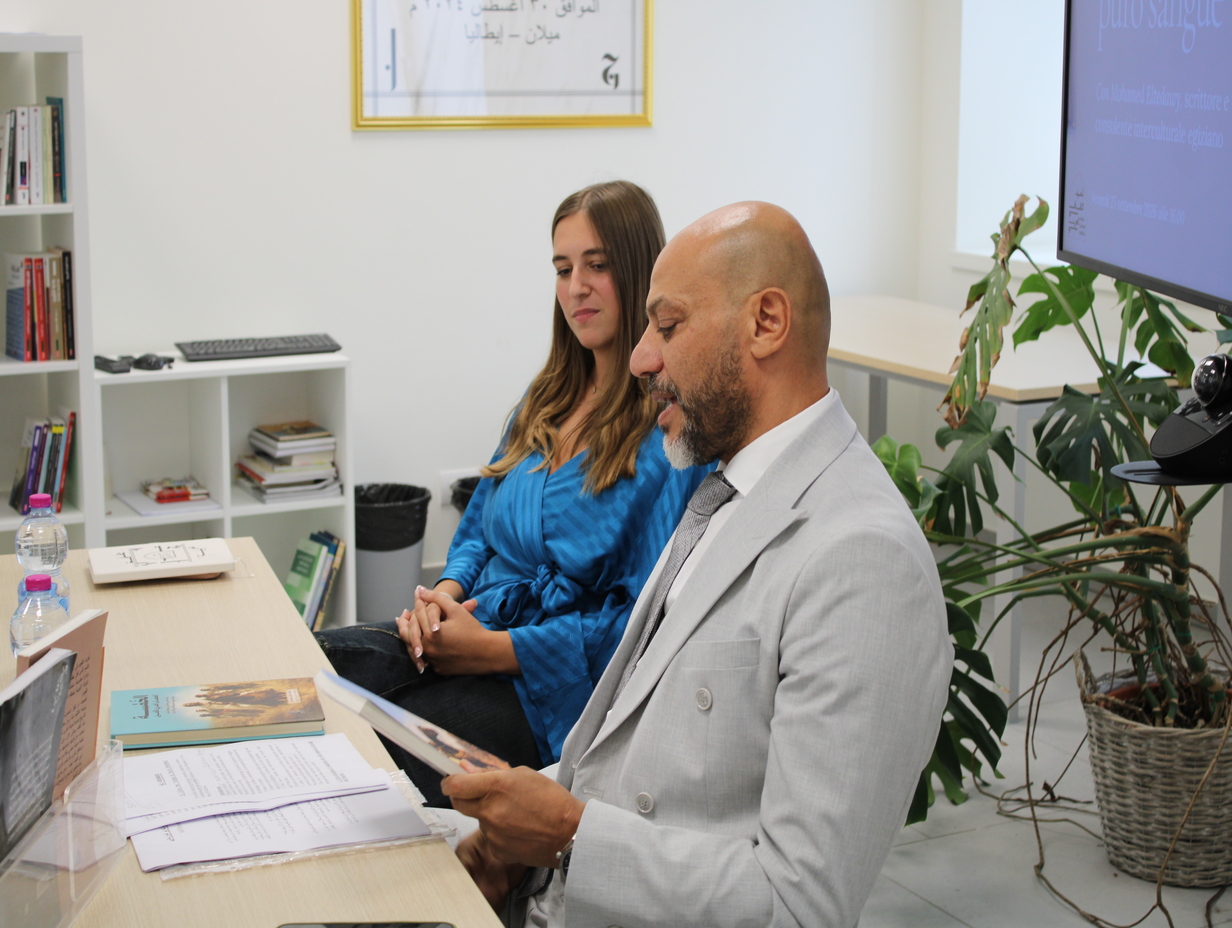
It is from this ancient poetic and cultural tradition that a story takes shape in which the horse is an integral part of human life in the desert. Dr. Mila Fantinelli, a PhD candidate in Arabic Literature at the Catholic University of the Sacred Heart and moderator of the event, explored this heritage in conversation with Mohamed Eltedawy, Egyptian writer and intercultural consultant, who was a guest speaker at the gathering.
The new 2026-2027 academic year of the Arabic Cultural Institute began precisely here: on Friday, September 25, 2026, at 4:00 p.m., with the presentation of El Kamsa - The Purebred Arabian Horse, Carlo Guarmani’s celebrated work, translated from Italian into Arabic by Mohamed Eltedawy.
The event offered an opportunity to rediscover, through Guarmani’s pages, the portrait of an animal that, in Arab civilization, is at once companion and emblem, deeply woven into the history and culture of the desert.
It is precisely from this ancient and unbroken bond that Guarmani’s account emerges. An Italian traveller and merchant of the nineteenth century, he approached the Arab world with an attentive and respectful gaze, capturing in his writings the echo of a millennia-old relationship between human beings and horses.
A horse expert as well as an explorer and Orientalist, Guarmani arrived in the Levant in 1850 and spent sixteen years there, learning the language of the people who welcomed him. In 1864, Emperor Napoleon III and King Victor Emmanuel II entrusted him with the task of acquiring purebred Arabian stallions. To accomplish this mission, he crossed the desert disguised as Khalil Agha.
Those years gave rise to a work suspended between scholarly treatise and travel diary. Its title refers to the five founding families of the Arabian horse - the Bedouin Khamsa. Guarmani regarded these bloodlines as the original stock of the breed and argued that the improvement of horse breeds depended upon the use of purebred stallions born and raised in their native desert environment.
The second edition, published in 1866, added an account of his journey through the Nejd. For this reason, El Kamsa – The Purebred Arabian Horse is today regarded as an important reference for the history of hippology and for the ethnography of the Arab world.
Today, those pages speak Arabic as well.
On this occasion, Mohamed Eltedawy presented his Arabic translation of Guarmani’s work. Through his translation, a book born from the author’s direct encounters with the Bedouins has returned, in their own language, to the land that inspired it.
As emerged during the presentation, the work offers a rare, perhaps even unique, perspective on a specific historical period and on a region for which comparable sources remain scarce.
And so, that first gathering of the new academic year became more than a book presentation. It became a tribute: from the Arab world to an Italian adventure that began in the desert and has now, in its own language, found its way home.